



Real estate does not operate on a fixed schedule.
Clients make decisions outside of business hours. Opportunities appear without warning. Deadlines are often non-negotiable. This does not mean the work must be chaotic, but it does mean it is reactive by nature. Agents who expect predictability tend to feel frustrated. Agents who plan for variability stay in control.
This article is not about color-coded calendars or blocking every 15 minutes of your day. It is about creating enough structure to protect what matters, without turning your week into something brittle.
Accept the reality before you try to control it
- Momentum is delayed. Closings happen 30 to 60 days after a deal goes under contract.
- Work clusters around client availability. Evenings and weekends are often the busiest. Showings, open houses, and serious buyer activity tend to peak on Saturdays and Sundays.
- Deadlines ignore personal schedules. Response delays can materially affect outcomes. Professional agents plan personal time around transaction pressure, not the other way around.
- Activity is uneven. One accepted offer can create dozens of tasks overnight. Periods of calm are often followed by compressed decision windows.
- Visibility requires ongoing time investment. Momentum fades when effort pauses. Trust is built long before a transaction exists.
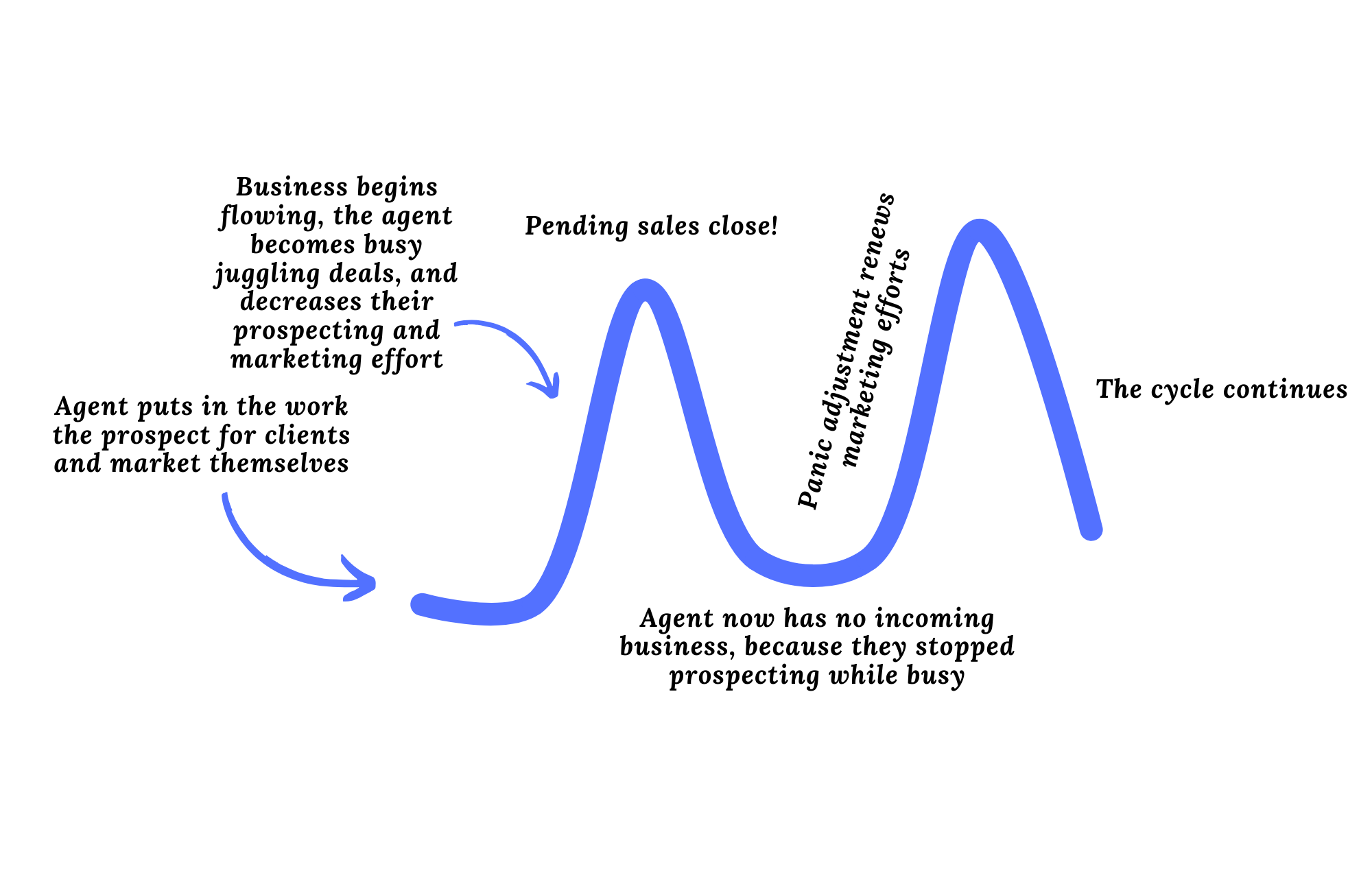
If you fight these realities, the week feels overwhelming. If you plan for them, the week becomes flexible and productive.
Time is the primary input
Time is the only resource you spend before you earn anything back.
A simple exercise makes this visible.
- Take your annual net income goal and divide it by 2,080 hours (work hours in a year).
- That number is what your time is worth. Once you see it, it becomes harder to waste.
Time blocking is simply a way of making sure important work actually happens. Some agents block their calendars tightly. Others work in broader themes. Some operate fully reactively.
There is no single correct format. What matters is that there is intentional structure and a reliable system behind it.
The blocks that matter most
Instead of scheduling your week minute by minute, think in categories.
CEO time is strategic thinking, planning, and big-picture decisions. This is working on the business, not in it.
Admin time covers email, paperwork, client updates, CRM upkeep, and backend maintenance.
An hour of power is one focused hour of lead generation and follow-up. Calls, texts, emails. No distractions.
Client work includes showings, listing appointments, inspections, and client-facing time. If you do not have clients yet, this becomes relationship building.
Marketing time is content creation, posting, newsletters, website updates, and light ad review. Consistency matters more than perfection.
Learning blocks are for skill building, scripts, coaching, reading, and professional development. These work best early in the day before everything fragments.
Days off are scheduled time away from work. Non-negotiable. Planning them makes them real.
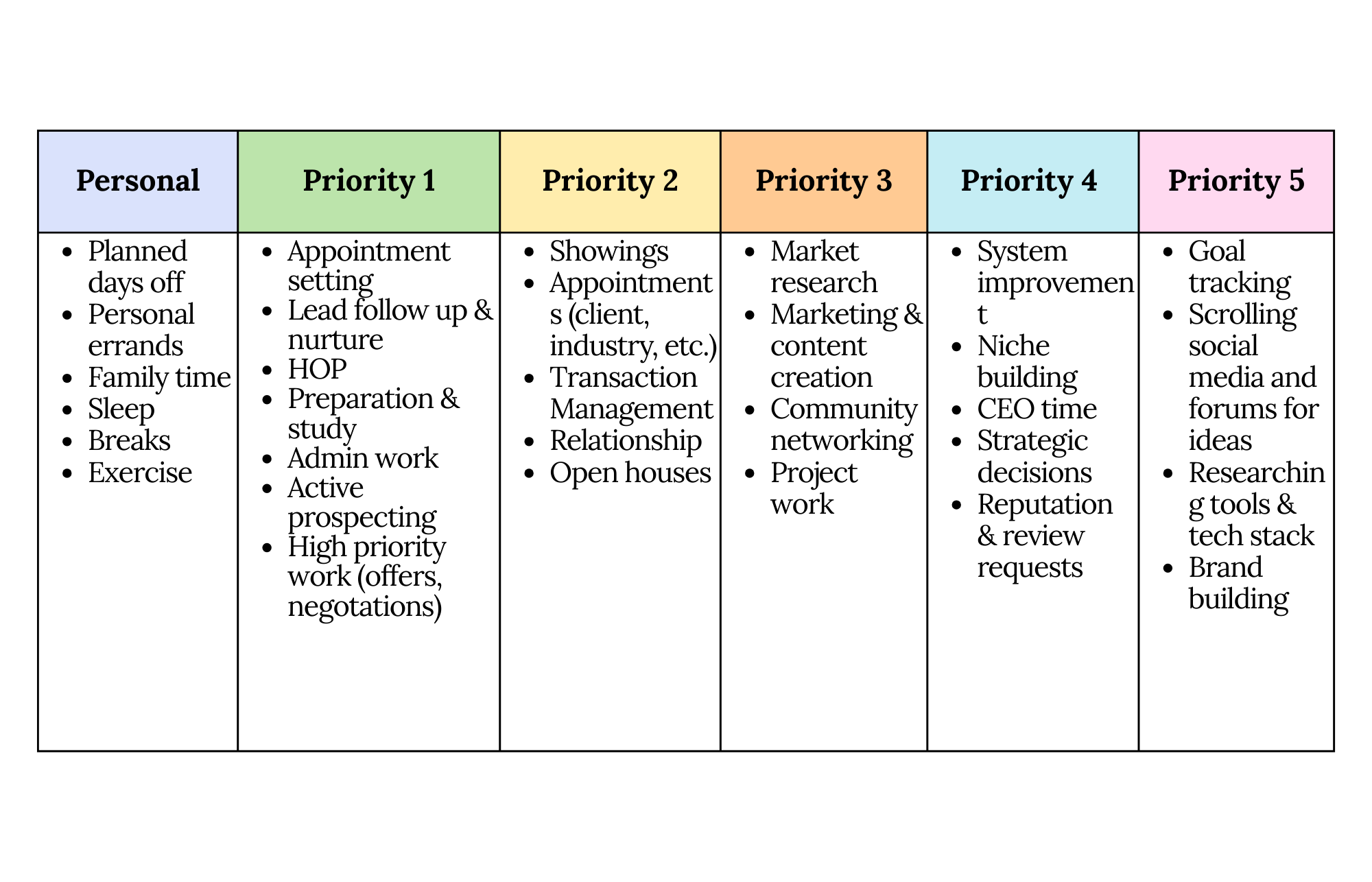
You do not need all of these every day. You do need them represented across the week. Not all tasks deserve the same amount of time.
Lead generation, follow-up, and relationship maintenance sit at the top. Preparation and administrative fundamentals support everything else. Showings and appointments are visible, but not the foundation. Marketing, networking, systems, and planning matter, but they should not crowd out the core.
A simple weekly structure forces you to notice what you are protecting and what you are avoiding.
The rule most agents ignore
Personal time belongs first.
You cannot be a successful agent if your life is constantly deferred. Blocking personal priorities, sleep, exercise, and days off is not indulgent. It's functional.
A flexible structure does not mean availability at all times. It means knowing when to be available and when not to be.
Being responsive is different from being constantly on call.
Your “Perfect Tuesday”
This is not about Tuesday. It is about your ideal model for any workday.
“Perfect Tuesday” is simply a stand-in for what a good, functional day looks like in your ideal situation. The goal is to sketch a realistic template you can reuse, not to lock yourself into a specific day of the week.
Write it out, start to finish. For example:
- Up at 7:00.
- Two focused hours of prospecting.
- Coffee break. Lunch.
- An hour of project or marketing work.
- Appointments in the afternoon.
- A clear stopping point in the evening.
Whatever your version is!
This is not meant to be a rigid schedule, but a model for you to aim for each workday. When your calendar starts to feel chaotic or you struggle to maintain your plans, this model gives you something to compare against. You can quickly see what is missing, what keeps getting pushed aside, and where your energy is better spent.
One clear model day is more useful than a perfectly planned week you never follow.
Build the Day Each Morning
Instead of trying to control the entire week in advance, build each day on its own.
Now that you have your "Perfect Tuesday" as a reference, each morning, often while you are having your coffee, decide what that day needs to look like. Start with what is fixed. Appointments, deadlines, negotiations, inspections, and anything time-sensitive.
Then build around what you can realistically contribute that day. Plan the work that fits the capacity you actually have, not the capacity you wish you had.
Anchor the day around one or two priorities that cannot be skipped. Prospecting, follow-up, or a critical project. Protect those first, then layer the rest around them.
This keeps you structured without being rigid and helps prevent giving up the moment your timeblocking can't be perfectly followed.
The goal is control, not rigidity
This kind of weekly structure gives you room to adapt without losing momentum. It protects business building while leaving space for the unpredictable nature of the job. You are not trying to control every hour. You are trying to control what does not get squeezed out, lost, and forgotten.
That is usually the difference between agents who feel constantly behind and agents who feel calm, even when they are busy.
Bellamy House Coaching - Learn More
Coaching & mentorship for new and growing agents who want direction, accountability, and a clear path to their first six figures. Led by Hunter Letendre — top producer + ACT/Brown University trained performance coach.
© 2025 Bellamy House. All rights reserved.
The resources, templates, and content provided are for educational and informational purposes only and do not constitute legal, financial, or business advice. Use of these materials does not guarantee specific results. By accessing this site and its materials, you agree not to reproduce, resell, or distribute any content without written permission.


