



If you stay in this business long enough, you start to notice something uncomfortable.
Two agents with equal talent and work ethic can be in the same office, in the same market, under the same broker. One steadily increases production year after year. The other stays busy but never quite breaks through.
It is tempting to explain that gap with personality, networking ability, or even luck. But over time, those explanations begin to fall apart. The agents who grow consistently are not necessarily louder, more extroverted, or better connected.
They operate completely differently from their peers.
Profitability in real estate is not built on energy alone, but is built on competencies that are often wildly overlooked by the majority of the industry. Many of these competencies will be picked up over time, but most agents never intentionally develop them. The ones who do separate themselves from the pack early and securely.
Here are the four that matter most.
Professional Judgment
Experience alone does not create judgment. Reflection on said experiences and pattern recognition do.
Profitable agents develop the ability to read situations accurately and respond without panic or emotion. They know when to push and when to pause. They understand when a client is emotionally reacting and when a negotiation truly requires movement. They can assess risk without dramatizing it.
Professional judgment shows up in pricing strategy, offer structure, inspection responses, and timing decisions. It prevents unnecessary escalation and reduces costly mistakes. You are the manager of your business, and of the transaction; it is not managing you.
Without strong judgment, agents become reactive and emotionally volatile. They overcorrect. They rely too heavily on scripts or the opinions of others. Over time, that instability limits growth and increases the likelihood of attrition.
Client Navigation
Markets shift. Emotional patterns of clients do not.
Many transactions do not fall apart because of pricing or rates. They fall apart because expectations were not set early, boundaries were not protected, or communication was inconsistent under pressure.
Strong agents guide clients through uncertainty with structure. They conduct clear buyer consultations. They outline realistic timelines with sellers. They handle objections without defensiveness. They protect their own time without damaging trust.
Client navigation is not about being agreeable. It is about leading the process. When that competency is weak, chaos increases. When chaos increases, production becomes unstable.
Check out our article about managing client emotions early.
Operational Structure
There is a meaningful difference between being busy and being structured.
A profitable agent has a rhythm to the week. There is time reserved for strategic review. The pipeline is visible. Follow-up is deliberate rather than random. Performance is reviewed instead of ignored. CEO time is a fundamental aspect of their week.
This does not require a complicated system. It requires consistency.
Without structure, agents operate in reaction mode. Text messages dictate the day. Fire drills consume attention. Months pass without evaluating what is working.
Structure is repetitive and often unremarkable. It is also the foundation of predictable income. Consider timeblocking if this resonates with you and your business.
Business Identity
This is the least discussed competency and often the most important.
There is a subtle but powerful shift between thinking of yourself as someone who closes homes and thinking of yourself as someone who runs a business.
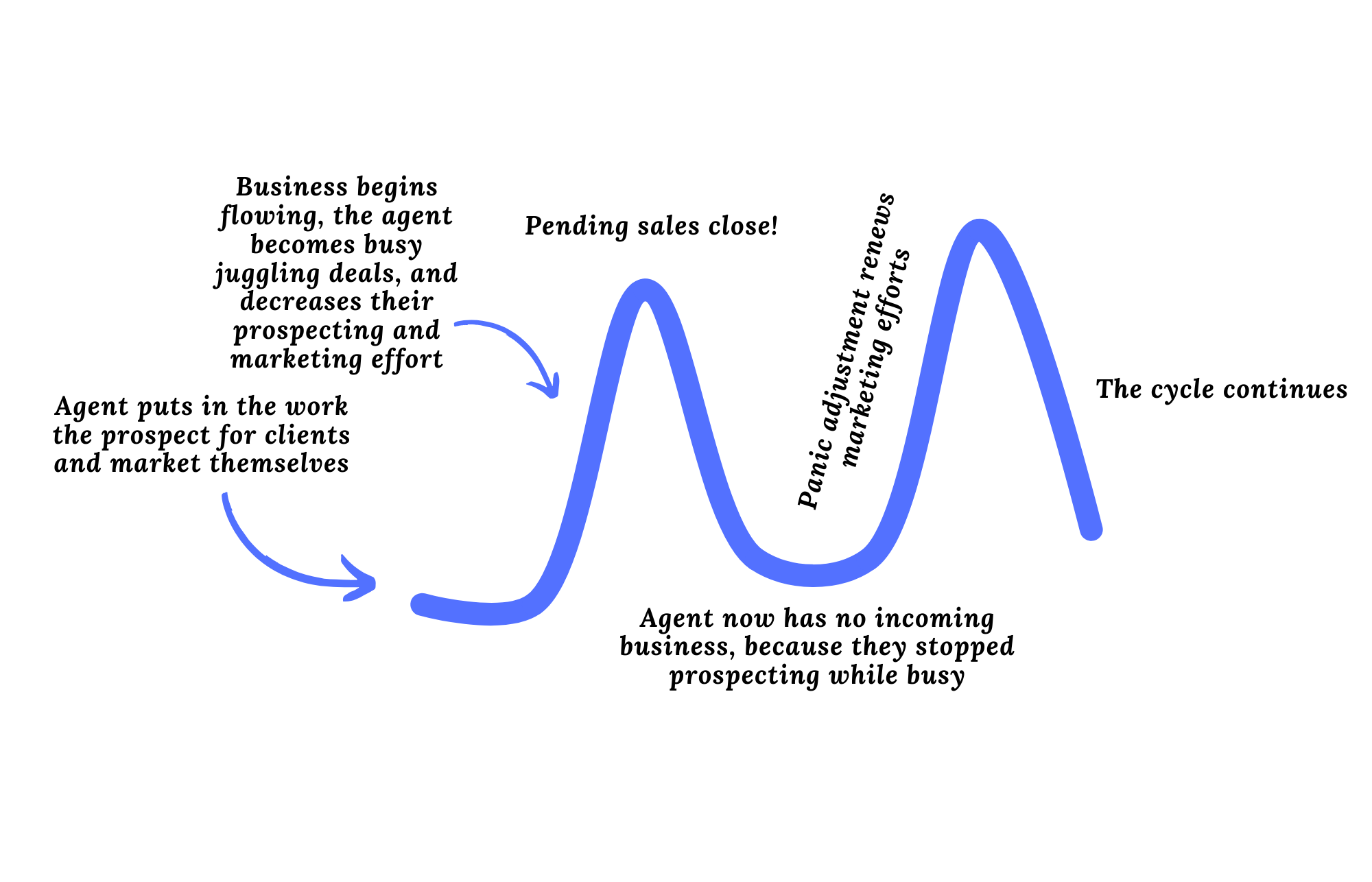
When you operate as a salesperson chasing the next deal, income rises and falls with individual transactions. When you operate as a business owner, you think in terms of systems, positioning, and long-term trajectory.
Identity shapes important business decisions. It influences how you price your services, how you negotiate, and how you invest your time. It determines whether you blame the market or examine your structure for the faults that are the foundation of the issues in your trajectory.
Most plateaus are not caused by lack of effort. They are caused by an identity that has not evolved with experience.
An Understanding Of Competency
This final layer is perhaps the most important, as it has to do with having a true awareness of where you stand.
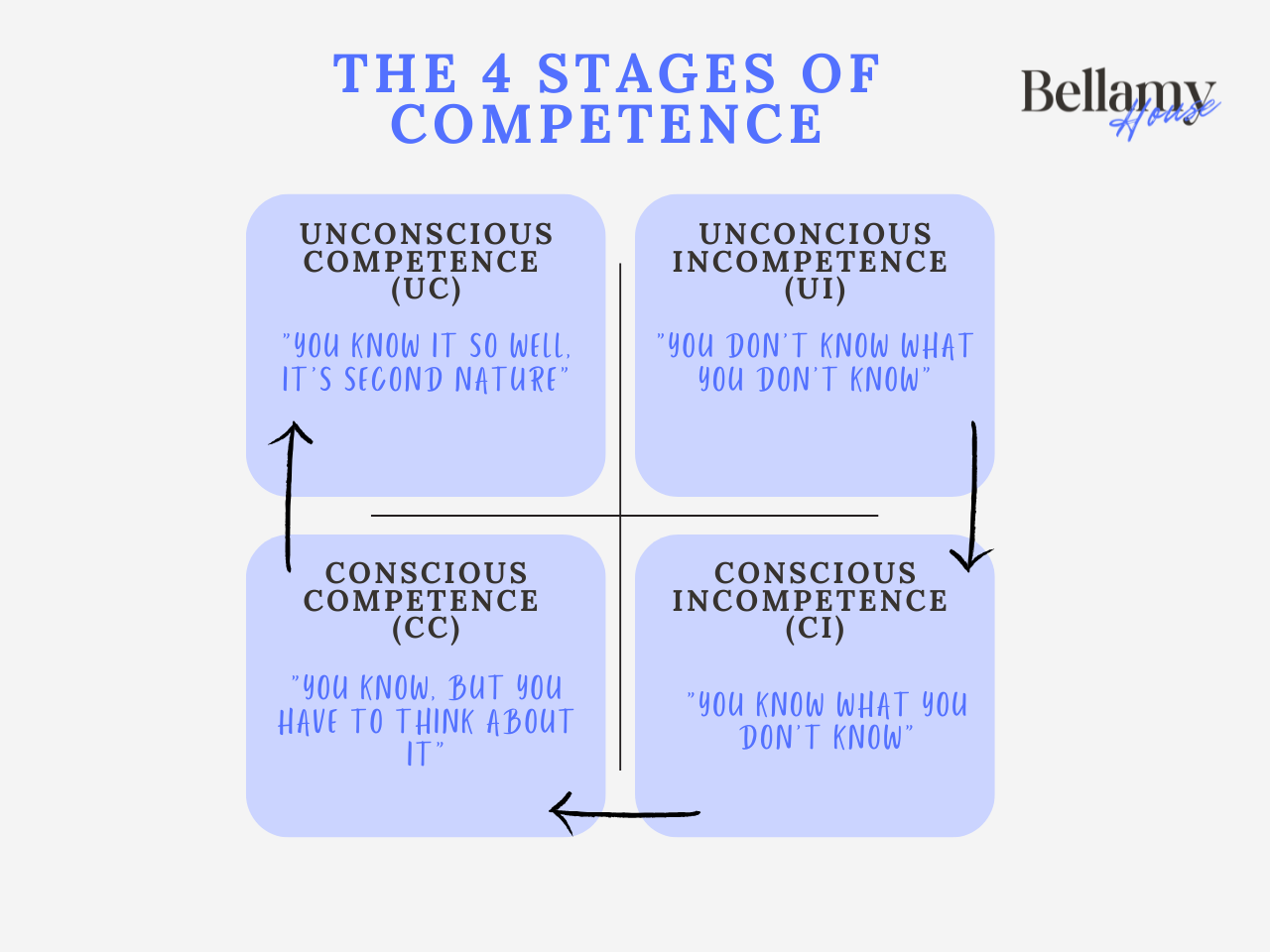
The Four Stages of Competence (sometimes called the Conscious Competence Model) is a framework that explains how people move from not knowing about something to mastering it.
Unconscious Incompetence
- “You don’t know what you don’t know.”
- At this stage, you’re unaware of the skills or knowledge you’re missing. (Example: A brand-new agent doesn’t even realize how much contract law, sales skills, or negotiation they’ll need to learn.)
Conscious Incompetence
- “You know what you don’t know.”
- Now you’ve realized the gaps. It can feel overwhelming, but awareness is the first step to growth. (Example: After your first training, you suddenly see how much you need to practice scripts, learn forms, and understand financing.)
Conscious Competence
- “You know, but you have to think about it.”
- You’re developing the skills, but you still have to focus and be deliberate. (Example: You can answer most questions, but still have plenty of situations where you need assistance or review, or need a moment to think through your answers.)
Unconscious Competence
- “You know it so well, it’s second nature.”
- The skill becomes automatic. (Example: You can walk into a listing appointment, ask the right questions, and handle objections without overthinking.)
A Different Question
When production slows, it is tempting to look outward. A new brokerage. A new CRM. A new lead source.
Those changes can support growth, but they cannot replace professional development. Before chasing more activity, ask yourself a better question.
Which of these five competencies is weakest in your business right now?
Growth in real estate rarely comes from doing more. It comes from operating at a higher level.
You can improve these competencies on your own. Most agents take years to do so. If you would rather accelerate the process and tighten the right areas immediately, apply for a Bellamy House coaching conversation.


